

Before I switched to dedicated contact management software, I was juggling a spreadsheet for leads, Gmail for conversations, and sticky notes for follow-ups. Every morning started with the same small panic: Who did I forget to follow back?
Turns out, that feeling is universal. According to Salesroom‘s State of B2B Sales Performance report (2024), 68% of sales professionals say note-taking and data input are their most time-consuming tasks, and 43% spend between 10 and 20 hours per week on admin work alone. That’s half a workweek not spent selling.
In this guide, I’ve reviewed 15 of the best contact management software tools for 2026, focusing on what actually matters for small and growing teams: ease of use, follow-up workflows, and honest pricing. Let’s get started!
What Is Contact Management Software?
Contact management software is a system that stores, organizes, and tracks all key details about your business contacts in one place. This includes names, phone numbers, email addresses, company names, past interactions, tasks, notes, and custom fields.
The core job: Give you a complete, searchable record of every contact so your team can follow up faster, personalize outreach, and never let a lead fall through the cracks.
If you want to go deeper on what this looks like in practice, this guide on what is contact management covers the fundamentals well.
What contact management software stores per contact:
- Full contact details (name, email, phone, social profiles)
- Interaction history (emails sent, calls made, meetings held)
- Notes and tasks assigned to that contact
- Tags, lists, or segments for targeted outreach
- Associated company or account details
- Files, documents, and custom field data
Why Do Basic Tools Fail at Scale?
Spreadsheets and Google Contacts work fine when you have 50 contacts. They break down fast when you reach 500, and they collapse entirely at 5,000.
Here’s what happens when you rely on basic tools:
The spreadsheet problem:
- No interaction history: You can’t see what was said last or when
- No automation: Follow-up reminders live in your head or a separate calendar
- No collaboration: Teammates overwrite each other’s data
- No segmentation: You can’t filter by engagement or deal stage
- Data decays fast: Phones change, companies merge, emails bounce
The real cost: A study by Gartner in 2021 found that poor data quality costs organizations an average of $12.9 million per year. For growing businesses, the damage shows up differently in missed callbacks, duplicate outreach, and deals that quietly die because nobody followed up.
If you’re already using a CRM and struggling with messy data, here’s a practical guide on how to keep CRM data clean before it becomes a bigger problem.
The fragmentation trap: Most small teams don’t have one contact problem; they have five. Contacts live in Gmail, LinkedIn connections, a spreadsheet, a phone’s contacts app, and the company inbox. None of them talk to each other. Contact management software solves this by pulling everything into a single system.
Quick Comparison: Top 15 Contact Management Software at a Glance
Not sure which tool fits your team? This side-by-side snapshot covers all 15 tools, what each does best, where pricing starts, and whether a free plan is available.
| Tool | Best For | Starting Price | Free Plan |
|---|---|---|---|
| BIGContacts | Easiest All in One CRM for Contact Management, Email Marketing & Deal Tracking | $9.99/month | Free for growing teams. Paid plan starts at $9.99/month |
| HubSpot | All-in-one sales, marketing, support | $15/user/month | Free CRM |
| Bigin | Simple automation for small teams | $5.8/user/month | Free tier |
| Streak | Gmail-native lead management | $59/user/month | Free tier |
| Pipedrive | Visual sales pipeline | $14/user/month | Not available |
| Zendesk Sell | Zendesk suite integration | $25/user/month | Not available |
| Monday.com | Project + contact management | $12/user/month | Not available |
| Covve | Personal networking | Custom | Free tier |
| Salesforce | Enterprise sales management | $165/user/month | Not available |
| Bitrix24 | Team workspace + CRM | $23.5/org/month | Free tier |
| Insightly | B2B workflow automation | $29/user/month | Free tier |
| Freshsales | AI-powered contact scoring | $8.8/user/month | Free tier |
| SugarCRM | Regulated industries | $19/user/month | Not available |
| Nimble | Social media integration | $29.9/user/month | Not available |
| Copper CRM | Google Workspace teams | $12/user/month | Not available |
1. BIGContacts – Easiest All in One CRM for Contact Management, Email Marketing & Deal Tracking
BIGContacts by ProProfs is a simple, affordable CRM built for growing businesses with contact management, email marketing, task automation, and sales pipeline tracking in one place.
What sets BIGContacts apart for small teams isn’t the feature count. It’s the combination of depth and simplicity. You get a complete 360° view of every contact: every email sent, every task completed, every note logged. And the automation is genuinely usable without a CRM administrator to set it up. The AI-powered dashboard adds one more layer on top of that, quietly flagging contacts that have gone quiet so nothing depends on someone remembering to check.
Pros:
- Centralized contact database with full interaction history (emails, calls, meetings, notes)
- Automated drip email campaigns triggered by contact behavior or date
- Visual sales pipeline to track deals from lead to close
- Static and dynamic contact lists that auto-update based on filters
- Task management with visual calendar and to-do lists
- Web forms to capture leads directly from your site
- 24/7 human support via phone, chat, and knowledge base
- AI-powered dashboard flags inactive contacts before they go completely cold
Cons:
- No downloadable or on-premise version
- No dedicated account manager for the free plan, unlike the paid version
How to Manage Contacts in BIGContacts:
1. Add Contacts
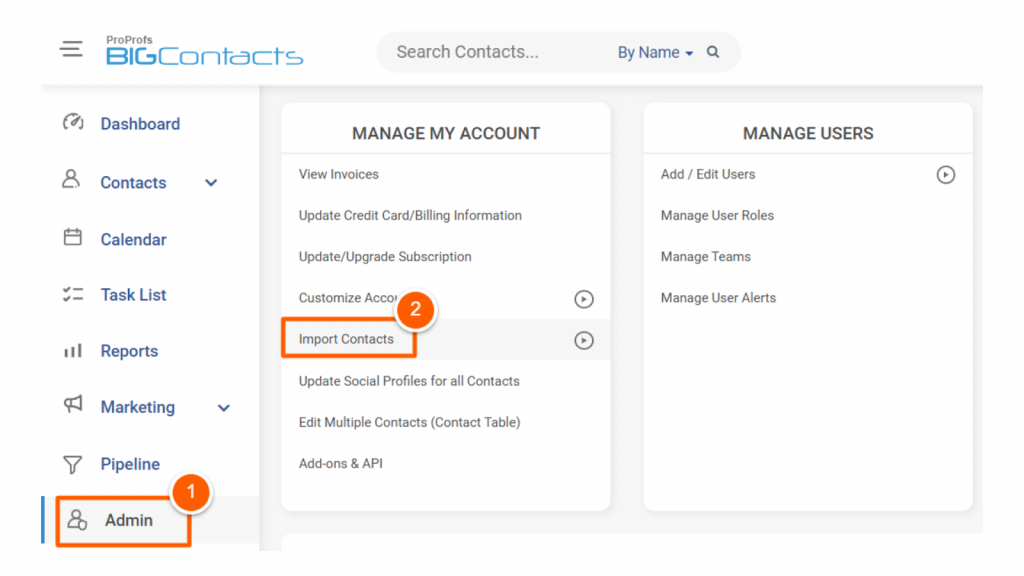
Manually enter individual details or import contacts in bulk using CSV or Excel files. You can also capture leads via web forms on your site.
2. Organize Contacts
Categorize contacts as leads, customers, or vendors. Use tags and custom fields to segment them based on interests or other traits.
3. Manage B2B Relationships
Link multiple contacts to a single company to view all interactions in one place and manage accounts more effectively.
4. Create Contact Lists
Build manual lists or create dynamic ones that update automatically based on filters like location, tags, or contact type.
5. Track Interactions
Quickly find contacts using search and filters. The Timeline View shows your full interaction history emails, calls, meetings, and more.
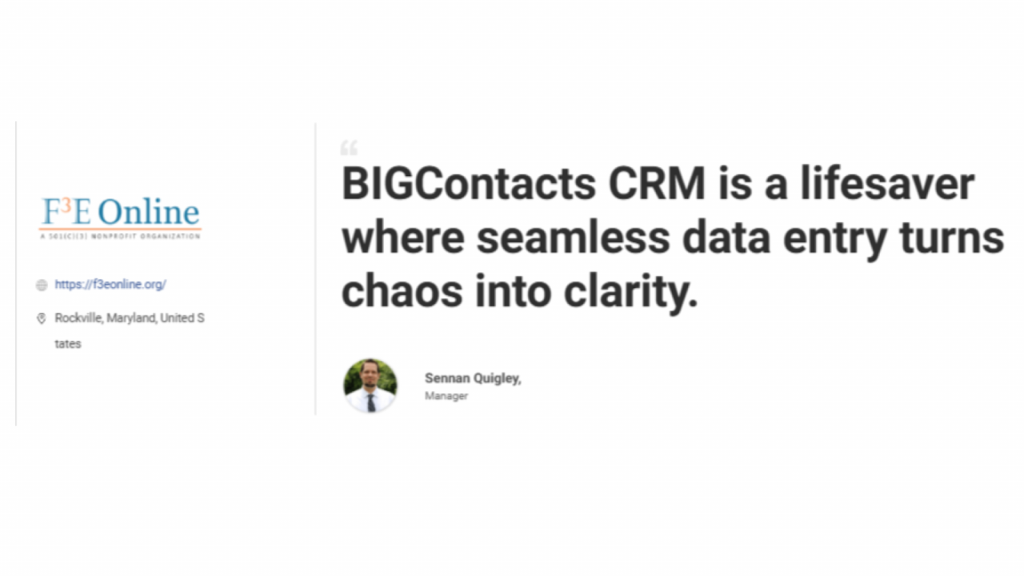
What one customer said: Sennan Quigley, a BIGContacts user, shared that the platform helped him consolidate scattered contact data and dramatically reduce time spent on follow-up management.
Pricing: A free plan is available for growing teams. Paid plan starts at $9.99/month.
Best for: Small and growing businesses and startups needing an affordable, no-complexity contact management system with built-in email marketing.
2. HubSpot CRM – Best for Centralizing Sales, Marketing & Support
I’ve found HubSpot CRM incredibly helpful for keeping everything, from contact details to follow-ups, organized in one place. It automatically enriches contact info, which makes it easier to personalize conversations without spending hours on research.
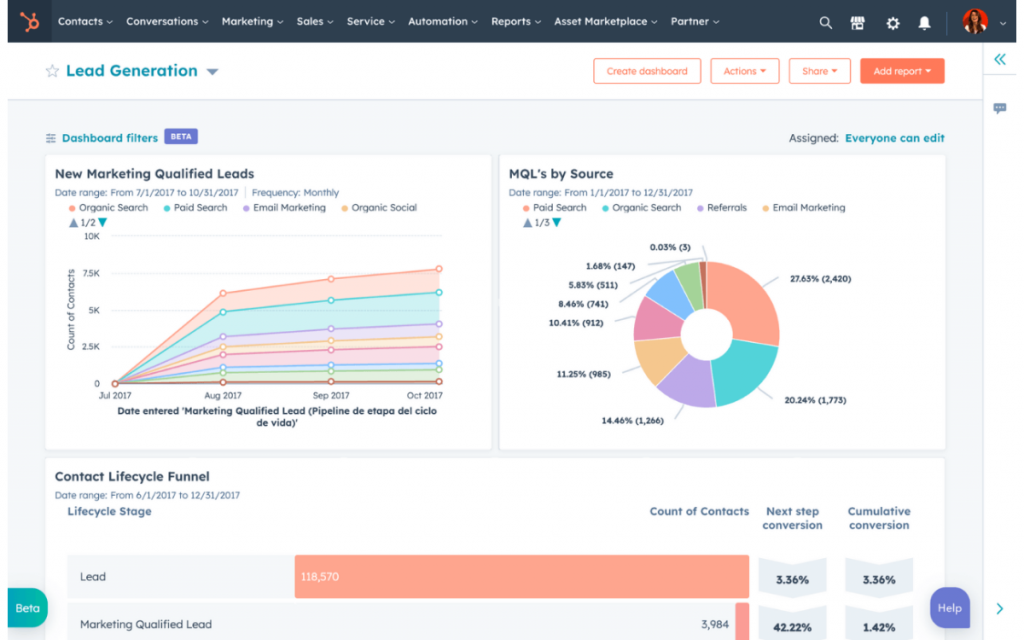
I can set up tasks, manage deals, and even track support tickets all from the same dashboard. The built-in analytics give me clear insights into what’s working and what’s not across sales, marketing, and service, which makes decision-making way easier.
Pros:
- Automatic contact enrichment from public data sources
- Visual workflow builder for lead nurturing and follow-up sequences
- Sales pipeline management with AI-powered deal insights
- Social media scheduling, live chat, and lead capture forms
- Cross-team visibility across sales, marketing, and service
Cons:
- Free plan is limited; most powerful features like automation and reporting are locked behind higher-tier paid plans
- Can feel overwhelming for small teams due to the sheer number of features and settings to configure
Pricing: Starts at $15/user/month. Free CRM plan available.
Best for: Teams that need unified visibility across departments and are ready to invest in a full-featured platform.
3. Bigin – Best for Marketing Automation in Small Teams
Bigin has been a great fit for my small business. It was simple to use and didn’t overwhelm me with features I didn’t need. I used it to keep my contact data organized, segment my audience, and send out targeted messages that felt personal.
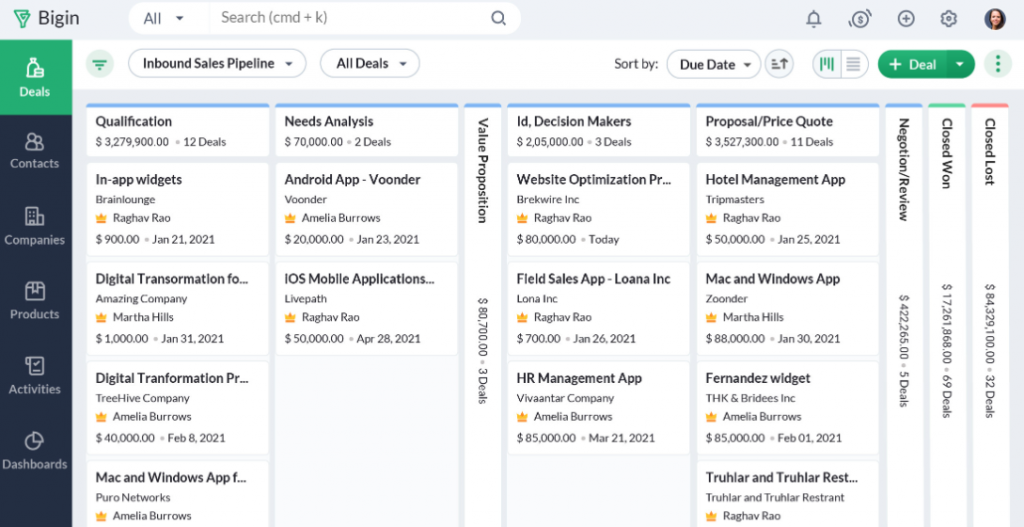
One thing I really appreciated was how it tracked customer behavior, which helped me plan more effective follow-ups. If you’re just getting started and need something simple yet smart, Bigin does the job really well.
Pros:
- Automatic contact segmentation based on customer behavior
- Multi-channel email campaigns with customizable templates
- Customer activity tracking to plan smarter follow-ups
- Custom interactions based on contact data and engagement
Cons:
- Fewer native integrations compared to more established CRMs, which can create workflow gaps
- Reporting and analytics are basic, making it harder to get deep insights into performance
Pricing: Starts at $5.8/user/month.
Best for: Small businesses getting started with automation who want simplicity over complexity.
4. Streak – Best for Lead Management Inside Gmail
When I used Streak CRM, what I loved most was how it worked right inside my Gmail, no switching tabs or learning a new system. It helped me manage my entire pipeline from my inbox, track emails, and see the full history of every contact in one place.
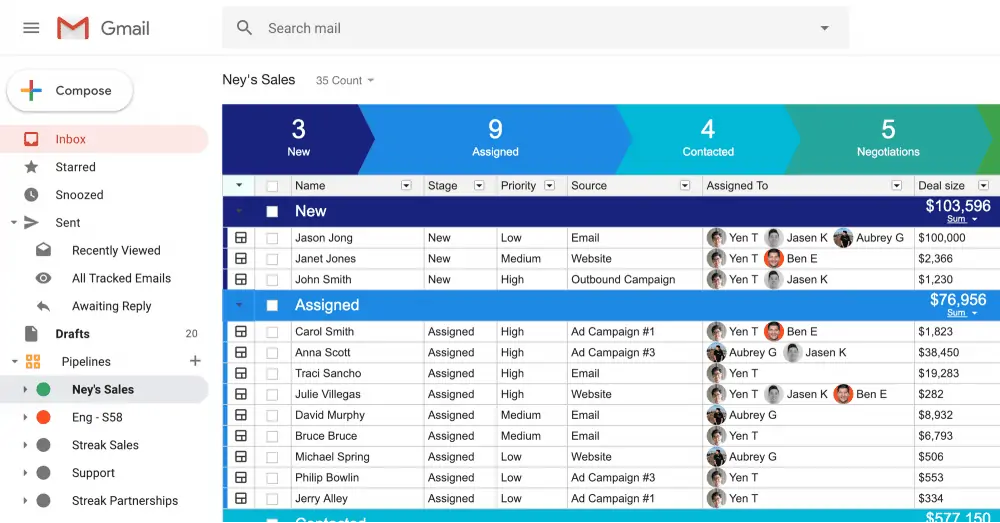
For someone juggling multiple conversations, it made follow-ups easier and way more personalized. It was perfect for keeping things organized without adding extra tools to my workflow.
Pros:
- Full pipeline management from your Gmail inbox
- Detailed activity timelines including cross-channel interactions
- Custom workflows for different team processes
- Sorting and filtering by any contact field or stage
Cons:
- Heavily dependent on Gmail, so it’s completely unusable if your team works outside the Google ecosystem
- Pricing jumps significantly at higher tiers, making it expensive for teams needing advanced features
Pricing: Starts at $59/user/month.
Best for: Solopreneurs and small sales teams who live in Gmail and want zero context-switching.
5. Pipedrive – Best for Visual Sales Pipeline Management
When I used Pipedrive, what stood out the most was how easy it made tracking deals with its drag-and-drop sales pipeline. Everything from contact details to follow-up tasks was right there in one place, which saved me a ton of time.
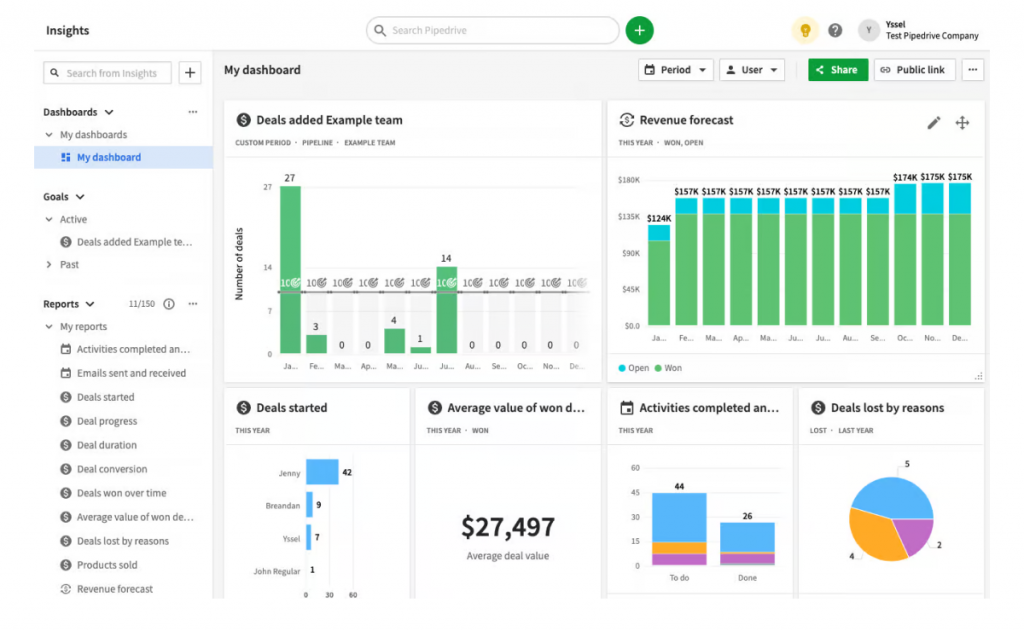
Image Source: Pipedrive
I could customize fields, tweak sales stages, and get a clear view of where each opportunity stood. It really helped me stay on top of my pipeline without feeling overwhelmed.
Pros:
- Drag-and-drop sales stages with custom fields
- Automated follow-up reminders and data entry tasks
- Multiple pipeline views for different products or teams
- Revenue forecasting from real-time pipeline data
Cons:
- Customer support features are minimal, so it’s not suitable for teams managing post-sale relationships
- Reporting customization is somewhat limited on lower-tier plans
Pricing: Starts at $14/user/month.
Best for: Sales teams that want a clear visual overview of every deal and contact at any given moment.
6. Zendesk Sell – Best for CRM Integration with Zendesk Support
Zendesk Sell made it really easy to bring our sales and support efforts together in one smooth workflow. Since we were already using Zendesk for customer service, adding Sell made it easy to keep everything in sync.
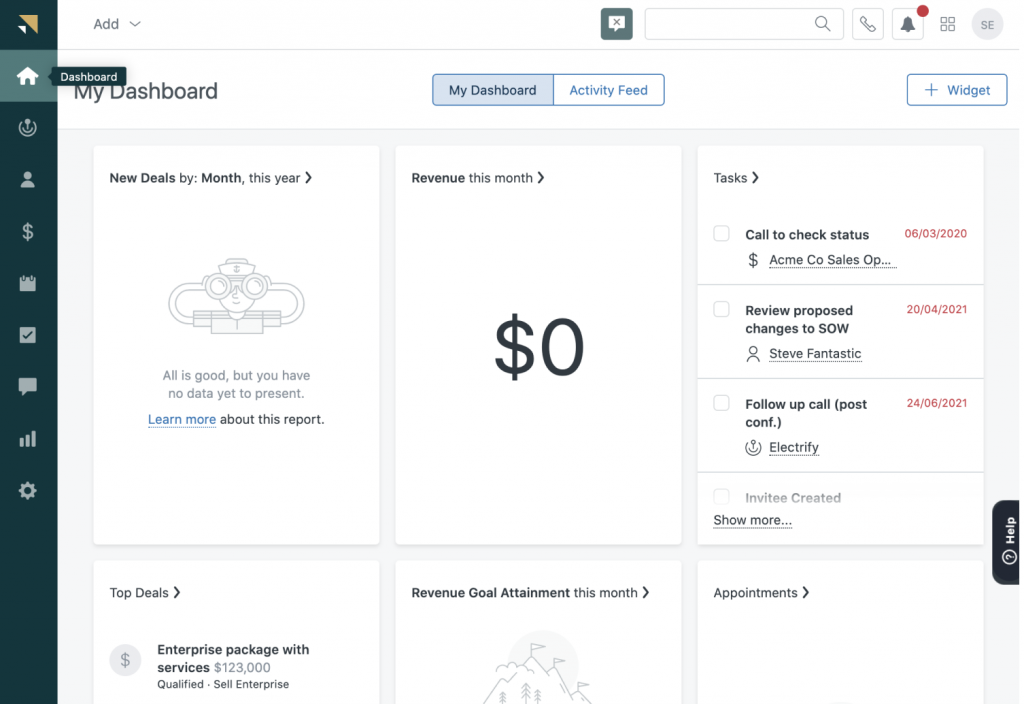
Image Source: Zendesk
It automatically pulled in contact info and updates, so we didn’t waste time on manual data entry. I could track deals, manage follow-ups, and see customer interactions all in one place. The built-in analytics also helped us spot what was working and where to improve.
Pros:
- Smart contact lists for segmentation and targeting
- Trigger-based email and task sequences
- Full customer interaction history across sales and support
- Custom dashboards with drag-and-drop metrics
Cons:
- Best value only for existing Zendesk Support users; standalone it feels expensive relative to competitors
- Interface can feel rigid and less intuitive compared to more modern CRM options
Pricing: Starts at $25/user/month.
Best for: Existing Zendesk users who want sales contact management without switching platforms.
7. Monday.com CRM – Best for Project-Oriented Teams
What I really liked about Monday CRM was how flexible it was. I could easily customize everything from pipelines, workflows, even the way tasks were displayed to fit exactly how my team worked. It helped me keep all our client info, updates, and conversations in one place, which saved a ton of back-and-forth.
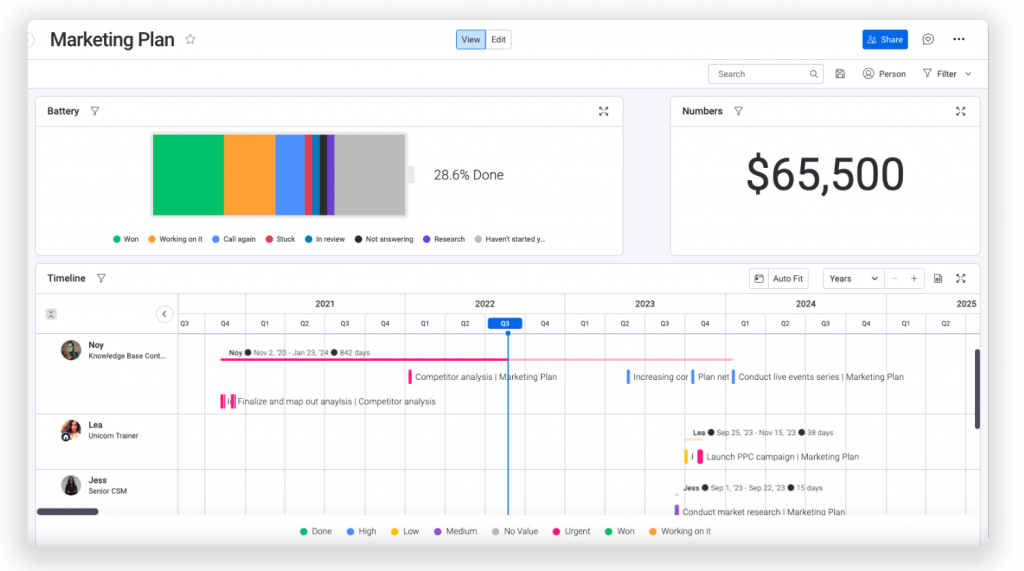
Image Source: Monday CRM
Whether I was managing a project, tracking follow-ups, or just organizing my day, monday.com made everything feel more connected and easier to stay on top of.
Pros:
- Contact cards with linked tasks, documents, and upcoming events
- Automatic interaction logging per contact record
- Highly customizable pipelines and workflow views
- Task automation for reminders, stage moves, and notifications
Cons:
- Pricing can get expensive quickly since most useful automations and integrations require higher-tier plans
- Not purpose-built as a CRM, so some sales-specific features feel less polished than dedicated tools
Pricing: Starts at $12/user/month.
Best for: Service businesses and agencies that manage both projects and contacts.
8. Covve – Best for Personal Networking and Relationship Management
Covve made it easy for me to stay organized and build stronger connections. It kept all my contacts in one place and reminded me to follow up at just the right time. I really liked how it tracked interactions and offered insights that helped me make every outreach more personal.
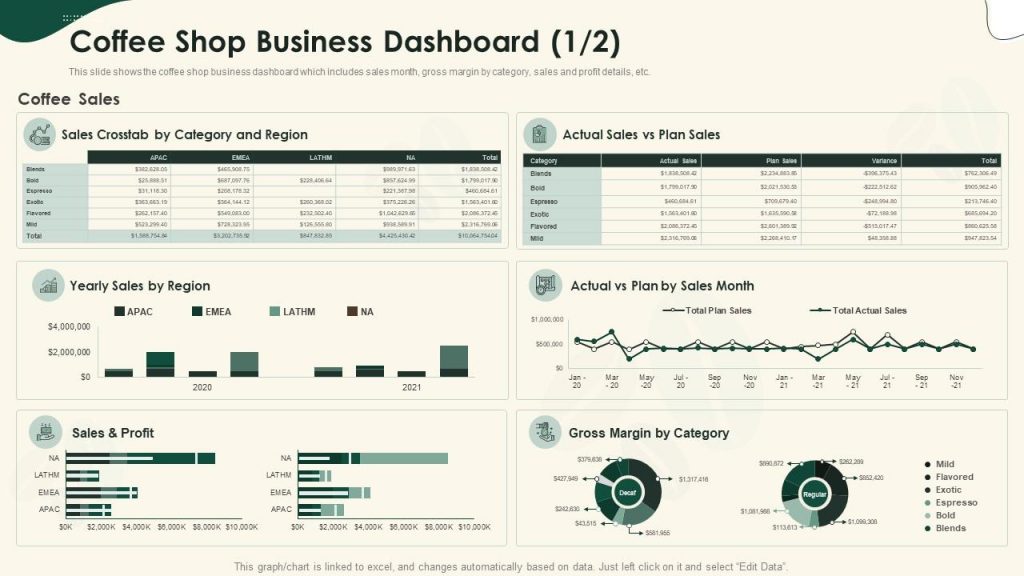
Image source: Covve
As a solo professional, it saved me a lot of time and helped me avoid missed opportunities. The smart reminders and networking analytics truly helped me stay on top of my client relationships.
Pros:
- Smart reminders to follow up at the right time
- Business card scanning to add contacts instantly
- Networking analytics to optimize outreach frequency
- Notes and context per contact record
Cons:
- Lacks team collaboration features, making it unsuitable for shared contact management across departments
- No native pipeline or deal tracking, so it’s not useful for managing an active sales process
Pricing: Custom pricing.
Best for: Consultants, freelancers, and solo professionals managing personal professional networks.
9. Salesforce CRM – Best for Enterprise Sales Management
Salesforce gave me everything I needed in contact management software and sales in one place, especially when things got complex. It had powerful tools like lead scoring, AI recommendations, and omnichannel tracking that helped me stay on top of every deal.
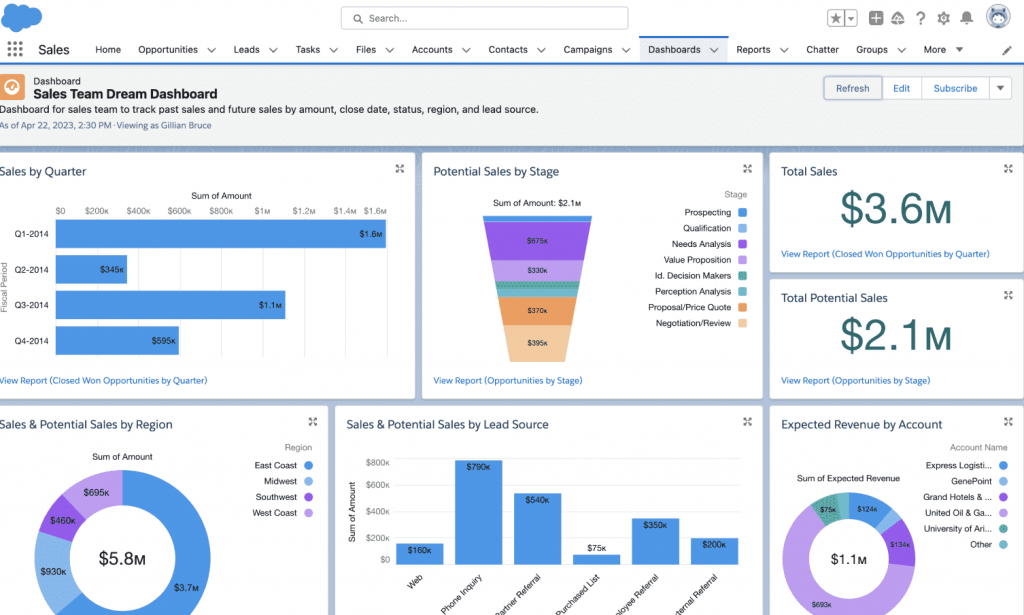
Image Source: Salesforce
What I liked most was how customizable it was. I could tweak almost everything to match how my team worked. The reporting was also a big plus, giving me clear insights to make better decisions and spot opportunities faster.
Pros:
- AI-powered lead scoring and sales recommendations (Einstein AI)
- Automated workflows and approval processes
- Omnichannel contact tracking (email, phone, chat, social)
- Real-time dashboards and custom reports
Cons:
- Steep learning curve that often requires dedicated admin support or professional implementation
- Heavy customization, while powerful, can make the system slow and complex to maintain over time
Pricing: Starts at $165/user/month.
Best for: Large sales teams with complex processes and dedicated CRM administrators.
10. Bitrix24 – Best for Online Team Workspace
Bitrix24 brought everything together for me with CRM, task management, document sharing, and even calls, all in one place. It helped me keep track of leads, manage projects, and collaborate with my team without jumping between tools.
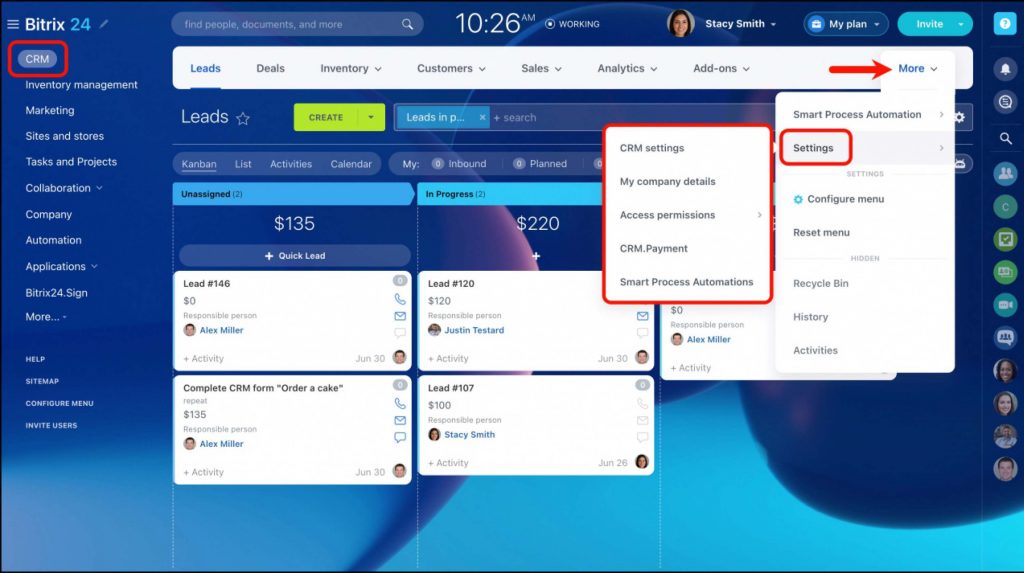
Image Source: Bitrix24
The automation features saved me time on repetitive tasks, and having shared access to client docs made teamwork a lot smoother. If you’re juggling multiple systems right now, Bitrix24 really helps pull everything together in one easy-to-use platform.
Pros:
- Contact Center dashboard for all interactions in one place
- Quotes, invoices, and payment management within the CRM
- Mobile access to all contacts, tasks, and documents
- Automation for repetitive workflows and communications
Cons:
- The interface feels cluttered and outdated compared to modern CRMs, which can hurt adoption
- The sheer number of features makes onboarding slow and the learning curve steep for new users
Pricing: Starts at $23.5/organization/month.
Best for: Teams replacing multiple tools (Slack, project management, CRM) with a single workspace.
11. Insightly – Best for Workflow Automation in B2B Teams
I used Insightly when our team needed one place to manage sales, marketing, and customer support without jumping between tools. It really helped us stay aligned, especially with long B2B sales cycles that required input from multiple departments.
Image Source: Insightly
I liked how it kept all our contact and project info organized, which made collaboration so much easier. The reporting tools were also super helpful. We could track performance and spot gaps without needing a separate analytics tool.
Pros:
- Multi-step automated workflows with conditional rules
- Drag-and-drop custom dashboards with real-time data
- Relationship linking to map organizational structures
- User role controls and data access authorization
Cons:
- UI feels dated and less intuitive compared to competitors like HubSpot or monday.com
- Mobile app experience is noticeably weaker than the desktop version, limiting on-the-go productivity
Pricing: Starts at $29/user/month.
Best for: B2B teams with complex, multi-department sales processes.
12. Freshsales – Best for AI-Powered Contact Scoring
Freshsales gave me a complete view of every contact, which made it so much easier to stay organized and follow up at the right time. It automatically captured contact details and tracked all my conversations in one place.
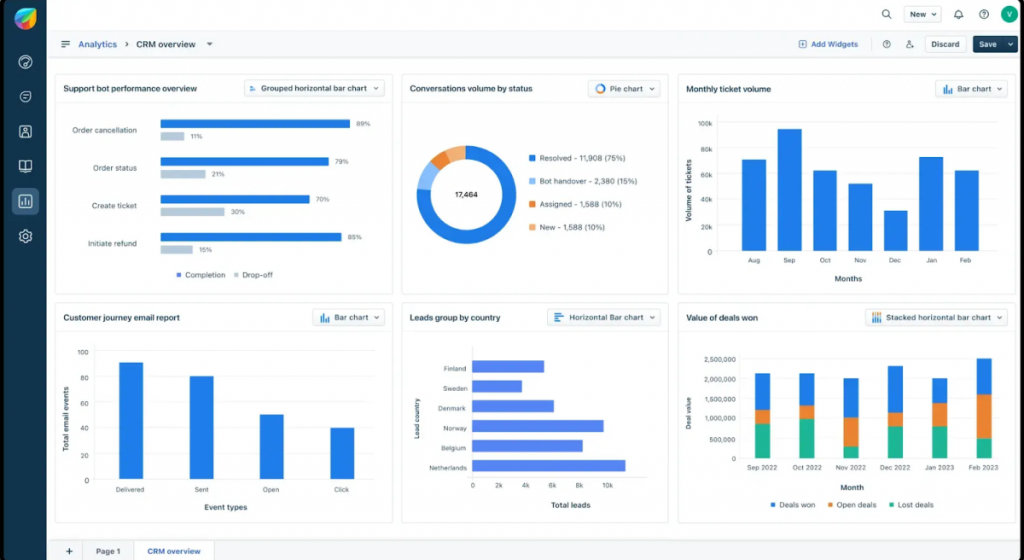
Image Source: Freshsales
I liked how it used AI to score leads and highlight who I should focus on next. The behavioral triggers were also super helpful for sending timely, relevant emails.
Pros:
- Automatic contact enrichment from public data sources
- AI-based lead scoring to surface highest-value contacts
- Behavioral email triggers for timely outreach
- Full interaction timeline per contact record
Cons:
- AI-powered features like lead scoring are only available on higher-tier plans, limiting value on entry plans
- Phone support is not available on the lowest pricing tier, which can be frustrating for new users
Pricing: Starts at $8.8/user/month.
Best for: Sales teams that want AI to help prioritize their contact lists and follow-up timing.
13. SugarCRM – Best for Regulated Industries Needing Customization
What I really liked about SugarCRM was how customizable it was. It felt like I could tailor every part of it to fit the way my business worked. It handled lead capture, follow-ups, and even complex workflows without a hitch.
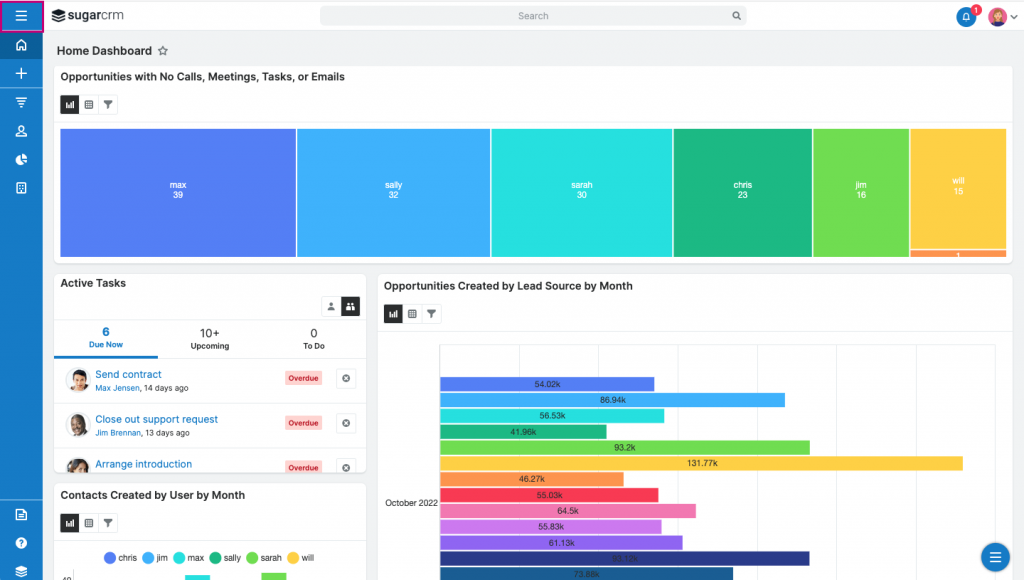
Image Source: SugarCRM
I used the contact management software to automate a lot of repetitive tasks, which saved tons of time. It was especially useful when I needed to stay compliant with strict data handling rules. If you’re in a regulated industry and want detailed control, it’s a solid choice.
Pros:
- Custom data fields and views for any workflow
- Multi-step engagement campaigns for customer nurturing
- Real-time performance alerts and revenue forecasting
- Data handling controls for compliance and privacy
Cons:
- Requires significant technical expertise to set up and customize, often needing IT or developer support
- The interface looks and feels outdated compared to more modern CRM platforms
Pricing: Starts at $19/user/month.
Best for: Mid-size businesses in regulated industries (finance, healthcare, legal) needing high customization.
14. Nimble CRM – Best for Social Media Integration
Nimble helped me bring all my contacts and conversations together in one place, which made managing outreach so much easier. It pulled in social profiles, past emails, and even upcoming meetings so I always had the full picture before reaching out.
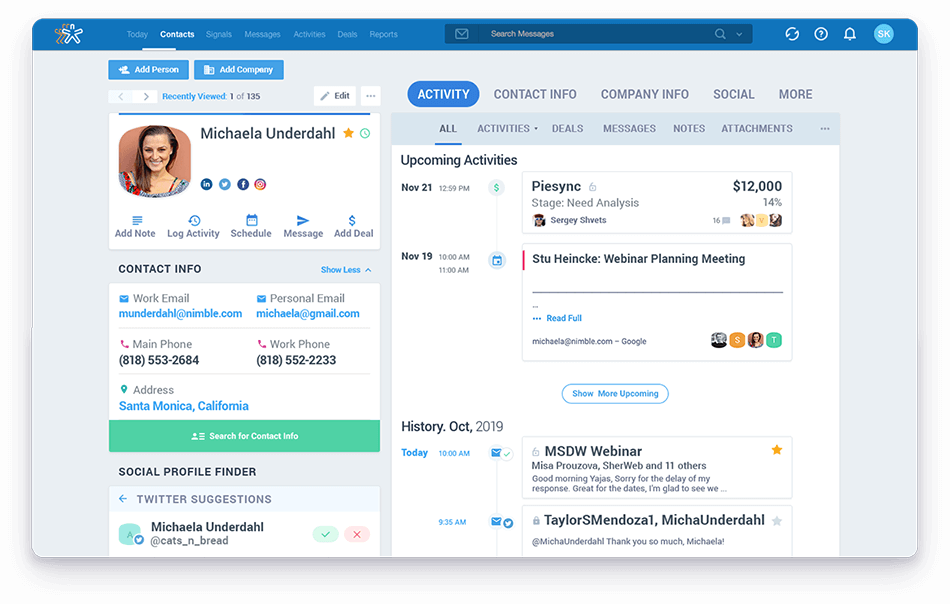
Image Source: Nimble CRM
As someone who was doing a lot of outbound marketing and client work, having those insights at my fingertips made my follow-ups feel more personal and saved me a ton of time.
Pros:
- AI-powered contact enrichment from social and web sources
- Email open and click tracking per contact
- Contact segmentation into targeted lists
- Visual pipeline with current deal stage per contact
Cons:
- Limited workflow automation compared to competitors, making it less suitable for scaling teams
- Reporting tools are fairly basic and may not satisfy teams that rely heavily on data-driven decisions
Pricing: Starts at $29.9/user/month.
Best for: Sales and marketing teams that prospect and nurture through social channels.
15. Copper CRM – Best for Google Workspace Users
Copper worked perfectly for me since my team already used Gmail and Google Calendar. It felt like a natural extension of our workflow no need to jump between tools. I could track emails, manage deals, and update contacts right from my inbox.
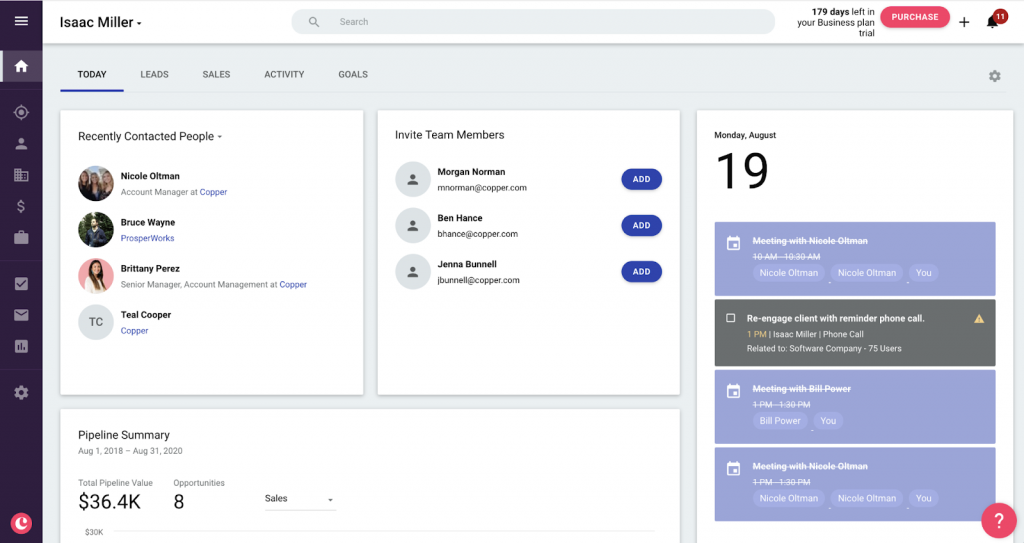
Image Source: Salesdorado
Adding new leads and setting follow-up tasks was super simple, which helped us stay organized and move faster. For a small team already in the Google ecosystem, it really streamlined our day-to-day work.
Pros:
- Manage contacts, deals, and tasks directly from Gmail
- Automatic contact record updates (phone, email, social)
- Tag and filter contacts by any custom criteria
- Live activity feeds within contact profiles
Cons:
- Exclusively designed for Google Workspace users, so it’s entirely unusable for teams on other platforms
- Lacks advanced marketing automation and customer support features found in more complete CRMs
Pricing: Starts at $12/user/month.
Best for: Small teams using Google Workspace who want a CRM with zero context-switching.
Just gone through all 15? Here’s a quick video comparing five of the top options side by side before we get to my top 3 picks.
My Top 3 Picks for the Best Contact Management Software
With 15 tools on this list, choosing where to start can feel overwhelming. Based on my evaluation, these three stood out the most for small and growing teams.
1. BIGContacts
BIGContacts by ProProfs is my top pick for small businesses that need a complete contact management system without the complexity or cost of enterprise CRM. It centralizes every contact detail, interaction history, task, and email campaign in one place, and the built-in automation makes follow-up consistency effortless even for a team of two. The forever-free plan means there’s no financial risk in getting started, and the 24/7 human support via phone and chat means you’re never stuck when something needs fixing fast.
2. HubSpot CRM
HubSpot earns its place here for teams that need more than contact management and are ready to centralize sales, marketing, and customer support under one roof. Its free CRM is genuinely capable, and the upgrade path is smooth as your team grows. The tradeoff is complexity because HubSpot rewards teams willing to invest time in configuration, and can feel like too much for businesses that just need a clean, simple contact database.
3. Pipedrive
Pipedrive is my pick for sales-focused teams that live and breathe pipeline visibility. Its drag-and-drop deal management makes it easy to see exactly where every contact stands in the sales cycle, and the follow-up automation keeps conversations moving without manual effort. It is narrower in scope than HubSpot but does its core job of moving deals forward better than almost anything else at its price point.
How Did I Evaluate These Contact Management Tools?
Every tool on this list was assessed using a consistent, six-point framework, no sponsored placements, no feature-count bias. Here’s exactly what went into each evaluation:
- User Reviews and Ratings: I cross-referenced verified reviews on G2 and Capterra, filtering specifically for feedback from small business users and growing sales teams and not enterprise customers with dedicated CRM administrators. Patterns in complaints like clunky imports, poor mobile experience, and slow support carried as much weight as average star ratings.
- Core Contact Management Depth: I evaluated every tool on whether it handles the fundamentals well: storing complete contact records, tracking full interaction history across emails, calls, and meetings, supporting custom fields, and enabling contact segmentation. Tools that only handled basic name-and-email storage without context didn’t make the cut.
- Ease of Setup and Daily Use: A contact management system only delivers value if your team actually uses it. I assessed whether a non-technical user could get fully set up, import real contacts, and run their first workflow within a single day. Complexity that requires training or a dedicated admin scored lower here.
- Follow-Up and Automation Capability: Since missed follow-ups are the single biggest revenue leak for small teams, I specifically evaluated each tool’s ability to automate reminders, trigger drip email sequences, and assign tasks based on contact activity without requiring a marketing operations background to configure.
- Pricing and Value: I evaluated whether each tool offers a meaningful free plan or an entry-level tier that both growing and small teams can actually afford, and whether the pricing scales reasonably as the team grows. Hidden costs like per-contact limits, feature paywalls, and mandatory annual contracts were flagged where found.
- Hands-On Testing and Expert Input: Ratings and feature lists only tell part of the story. I assessed each tool through direct testing where possible, supplemented by insights from sales professionals and small business operators who use these platforms in their day-to-day work. The goal was to surface real-world usability, not just spec-sheet performance.
Before/After: Spreadsheet vs. Contact Management Software
If you’ve ever spent 20 minutes hunting for a contact’s last email, or discovered a follow-up slipped through the cracks because it lived in a sticky note, this comparison will feel familiar. Here’s what the same task looks like in a spreadsheet versus a dedicated contact management system:
| Scenario | Spreadsheet | Contact Management Software |
|---|---|---|
| Finding a contact | Ctrl+F through rows | Search bar with filters |
| Seeing last interaction | Not possible | Full timeline view |
| Setting a follow-up reminder | Separate calendar app | Built-in task and reminder |
| Sending a campaign | Manual copy-paste into email | Automated sequence by segment |
| Onboarding a new rep | "Here's the spreadsheet, good luck" | Shared database, full history |
| Reporting on deals | Manual tallying | Dashboard with live metrics |
| Data going stale | No alerts | Auto-enrichment or alerts |
What Does Disorganized Contact Management Actually Cost You?
Most teams underestimate the revenue impact of contact chaos. Here’s what the data shows:
According to a study by Forrester Research in 2024, companies that excel at lead nurturing generate 50% more sales-ready leads at 33% lower cost than those that don’t. The gap isn’t talent, it’s systems. You can verify this finding via Forrester’s research on lead nurturing.
The revenue leak happens in three places:
1. Follow-up Timing
Leads go cold fast. Companies that respond to a web lead within an hour are more likely to have a meaningful conversation with a decision-maker than those who wait two or more hours. When follow-up reminders live in your head or a spreadsheet, timing suffers.
2. Context Loss
When a prospect calls back, and the rep has no record of the last conversation, trust drops immediately. Contact management software fixes this by surfacing the full interaction timeline before the rep picks up the phone.
3. Duplicate and Missed Outreach
Without a shared system, two reps contact the same lead on the same day, or no one contacts a warm lead for three weeks because everyone assumes someone else is handling it.
Simple Contact Management vs. Full CRM: What Do You Actually Need?
This is one of the most common questions small business owners ask, and the answer is simpler than the software vendors want you to think.
You need contact management software if:
- You manage contacts across email, phone, and spreadsheets, and regularly lose track of follow-ups
- Your team is 1–10 people, and you need a shared, searchable contact database
- You want automated follow-up reminders without complex setup
- Your budget is under $20/user/month
You need a full CRM if:
- You have dedicated sales, marketing, and support teams with different workflows
- You need advanced reporting, territory management, or revenue forecasting
- You’re managing thousands of contacts with complex deal stages
- You have a CRM administrator or technical resource to manage the platform
For most businesses, a full CRM is overkill at the start. A well-configured contact management system like BIGContacts by ProProfs, with contact tracking, email automation, and pipeline management, gives you 80% of the value at a fraction of the cost and complexity.
If you’re still unsure where you fall, this breakdown of CRM vs contact management software lays out the differences without the jargon.
What Happens When You Never Miss a Follow-Up Again?
The best-performing sales teams aren’t more talented. They’re more consistent. And consistency doesn’t come from willpower, memory, or a well-organized inbox. It comes from systems that make the right action impossible to miss.
When every contact has a follow-up task with a due date, three things change permanently:
1. Response Rates Climb
Most sales conversations require multiple touchpoints before a prospect is ready to move forward. The problem isn’t that salespeople don’t know this; it’s that without a system, follow-up numbers three, four, and five never happen because there’s nothing prompting them.
Automated reminders and drip sequences remove that dependency on memory entirely. Setting these up doesn’t have to be complicated. Here’s how email drip campaigns work and when to use them.
Your team follows up consistently, not because they’re disciplined, but because the system makes it the path of least resistance.
2. Deals Move Faster
There’s a specific kind of friction that slows every sales conversation: the rep who has to ask “just to recap, where did we leave off?” before they can say anything useful. It signals to the prospect that they’re not a priority.
When reps walk into every call with a full interaction timeline: every email sent, every note logged, every previous conversation summarized, they skip the recap entirely and get straight to advancing the deal. That shift alone can compress a sales cycle by days.
If you want to understand how this connects to a broader process, this guide on how to build a sales pipeline is worth reading alongside it.
3. Nothing Slips Through
A contact marked “revisit in Q2” doesn’t get forgotten. The system resurfaces it when Q2 arrives. A prospect who said “call me after the holidays” gets a task that fires on January 3rd. A customer who hasn’t been contacted in 60 days gets flagged before they start feeling neglected.
This kind of invisible consistency is what separates teams that retain customers effortlessly from teams that are constantly scrambling to rebuild relationships they let go cold.
4. What This Looks Like in Practice
Imagine a 10-person sales team that closes an average of 8 deals per month. If just two of those deals were previously slipping through the cracks, warm leads who went quiet after the second touchpoint, a follow-up system that reliably gets to touchpoint four or five doesn’t just save those deals.
How to Choose the Right Contact Management Software for Your Business
Choosing a tool based on the longest feature list is how teams end up with software nobody uses. The right contact management system isn’t the one with the most capabilities; it’s the one your team will actually open every morning. Here’s a practical five-step framework to find it.
Step 1: Identify Your Biggest Contact Pain Point
Before you look at a single pricing page, get honest about what’s actually breaking down in your current workflow. Lost follow-ups mean you need automation and reminder triggers. Fragmented data across Gmail, spreadsheets, and your phone means you need strong import tools and a centralized database. Team coordination issues mean you need shared access and task assignment.
Campaign outreach problems mean you need segmentation and drip email tools. If you’re unsure which problem is biggest, ask yourself: What’s the last deal we lost that a better system could have prevented? The answer usually points directly to the gap.
Step 2: Match Your Team Size and Budget
The best CRM for a 3-person startup is not the best CRM for a 50-person sales floor. If you’re a team of 1–5, start free, BIGContacts offers a forever-free plan with full contact management and email features, and HubSpot and Freshsales also offer free tiers worth testing. For teams of 5–20, budget $10–$30/user/month and prioritize ease of use over feature depth, because at this size low adoption kills ROI faster than missing features ever will.
For 20+ people, evaluate platforms like Salesforce, Insightly, or SugarCRM, but factor in the cost of a dedicated admin to manage configuration, because enterprise tools rarely run themselves.
If pricing is a key factor in your decision, this CRM pricing guide breaks down what you should actually expect to pay at different team sizes.
Step 3: Check Integration With Tools You Already Use
A contact management system that doesn’t talk to your existing tools creates new friction instead of removing it. Map out every platform your team uses daily before shortlisting anything, Gmail or Google Workspace users will find BIGContacts and Copper the most natural fit, Outlook-heavy teams should look at HubSpot or Pipedrive, and anyone already running Zendesk for support should evaluate Zendesk Sell to keep sales and service data in sync.
The integration test is simple: if a rep closes a deal in the CRM today, does the update appear everywhere else it needs to be automatically, without anyone copying and pasting?
For a detailed look at how these connections work in practice, this guide on CRM integration covers the most common setups.
Step 4: Test With Real Data, Not Demo Data
Every tool looks good in a vendor demo with pre-loaded sample contacts and clean workflows. The only meaningful test is running the tool with your actual contacts, your actual follow-up scenarios, and every team member who will use it daily for at least two weeks.
Import 100 real contacts, recreate your three most common workflows, and at the end of the trial, ask each person one question: Would you miss this tool if it disappeared tomorrow? If more than one person says no, the tool isn’t the right fit, regardless of how strong the feature list looks.
Step 5: Ask the Vendor Hard Questions Before You Buy
The questions you ask before signing up reveal more about a vendor than their marketing site ever will. Ask how long a full contact import takes, whether there’s a built-in deduplication tool, and most importantly, whether you can export all your data if you decide to leave.
Any vendor that hesitates on that last question is betting on lock-in rather than on delivering value. Also, confirm what customer support looks like: email-only with 48-hour response times is fine for a solo user, but a growing team needs live chat or phone support during business hours at minimum.
Start Managing Contacts Like a System, Not a Habit
The difference between teams that consistently close deals and those that constantly chase leads usually comes down to one thing: do they have a system, or do they rely on memory?
Contact management software isn’t about adding more tools to your workflow. It’s about replacing the mental overhead of tracking dozens of relationships with a system that does it automatically so you can focus on conversations, not logistics.
For teams ready to move off spreadsheets without the complexity and cost of enterprise CRM, BIGContacts by ProProfs is one of the most practical starting points. It covers the core jobs like centralized contacts, interaction history, email automation, and follow-up tasks on a forever-free plan that doesn’t expire after 14 days.
The best contact management system is the one your team will actually use, consistently, every day. Start simple, pick the tool that removes the most friction from your current workflow, and build from there.
Frequently Asked Questions
What Is the best free contact management software for small businesses?
BIGContacts offers a permanently free plan with full contact management, task tracking, and email features—not just a 14-day trial. HubSpot and Freshsales also offer free tiers, though with feature restrictions at higher contact volumes.
How much does contact management software cost?
Pricing ranges from free to $165/user/month depending on the platform and features. Most small business tools fall in the $9–$30/user/month range. Tools like BIGContacts start free and scale affordably as your team grows.
Can contact management software import contacts from a spreadsheet?
Yes. Most contact management platforms, including BIGContacts, HubSpot, and Pipedrive, support bulk CSV import with field mapping. You can typically migrate an entire spreadsheet database in under an hour.
Is contact management software worth it for a solo business owner?
Yes. Even solo operators benefit from a contact management system because it replaces the mental load of tracking follow-ups with an automated system. Tools like Covve and BIGContacts are specifically designed for individual users at low cost.
You can also explore this roundup of the best personal CRM tools if you're managing relationships solo.
What should I look for in contact management software for sales teams?
Prioritize interaction history tracking, automated follow-up reminders, contact segmentation for targeted outreach, and integration with your email client. Pipeline visibility is a strong secondary feature for active sales teams.
How do I migrate contacts from Google Contacts to a CRM?
Export your Google Contacts as a CSV via Google Contacts → Export, then import that CSV into your chosen contact management tool. Most platforms provide field mapping during import to match column headers to contact fields.
Does contact management software work on mobile?
Most modern platforms include mobile apps or responsive web interfaces. Bitrix24, BIGContacts, and Salesforce all offer mobile access so you can view and update contacts remotely.
What is the difference between static and dynamic contact lists?
A static contact list is manually curated and doesn't change unless you update it. A dynamic list auto-updates based on defined filters—for example, automatically adding any contact tagged "lead" in a specific city. BIGContacts supports both list types.
How does contact management software help with follow-up consistency?
The platform assigns due-date tasks to contacts, sends automated reminder sequences, and tracks which contacts haven't been touched in a set number of days. This removes follow-up from your memory and puts it in a system that prompts action at the right time.
Can small businesses use contact management software without technical setup?
Yes. Tools like BIGContacts and Bigin are built for non-technical users. Most offer onboarding guides, CSV imports, and pre-built templates that allow a solo founder or small team to get fully set up within a day.
What integrations should a contact management system have?
Look for native integration with your email client (Gmail or Outlook), calendar (Google Calendar or Outlook Calendar), and any tools you use for billing, support, or marketing—such as QuickBooks, Mailchimp, or Zendesk. BIGContacts integrates with all major email providers and a wide range of business tools.
FREE. All Features. FOREVER!
Try our Forever FREE account with all premium features!