
Whenever I work with teams on their CRM challenges, I hear the same things. Customer data lives in too many places, everyone is switching between multiple systems, forecasting isn’t as reliable as it should be, and teams are expected to respond faster with fewer resources. I know how frustrating that can feel because these issues slow down growth and customer relationships.
That’s where CRM statistics make a real difference. Instead of relying on guesswork, you can use solid data to understand how top-performing companies manage their customers, where they invest, and which CRM and AI capabilities actually move the needle.
In this guide, I’ve brought together the most credible CRM stats available today. Use them to sharpen your strategy, support your budget decisions, and build a CRM setup that truly helps your team work smarter and serve customers better.
Let’s get started!
Why CRM Statistics Matter
When you look at CRM tools, everything can sound similar. Every platform promises better relationships, more revenue, and happier customers. What actually cuts through the noise is data.
CRM statistics show you what is really happening in the market. Instead of guessing, you can see:
- How fast CRM is growing
- Where other companies are investing
- What kind of results they are getting from their CRM and AI
For you, this is not just about “nice to know” numbers. It is about making smarter decisions.
- If you are fighting for budget, stats help you show leadership why CRM and AI are worth investing in.
- If you are choosing features, numbers around usage and ROI can tell you whether to focus on sales automation, customer service, analytics, or mobile access first.
- If you are benchmarking your team, CRM stats show whether you are ahead of the curve or quietly falling behind your peers.
A modern CRM now sits at the center of how you grow revenue, keep customers happy, and run your processes more efficiently.
The statistics in this blog help you connect all three:
- Revenue and pipeline – Are you using CRM in a way that actually moves deals forward and improves forecast accuracy?
- Customer experience and retention – Are you using your CRM data to keep customers for longer and personalize their journeys?
- AI-driven automation and insight – Are you taking advantage of AI inside your CRM, or still doing things manually that others have already automated?
As you go through the CRM stats below, you can think in simple terms:
- “Where are we already strong?”
- “Where are we behind?”
- “What is the one change we can make this year that will have the biggest impact?”
Global CRM Market Statistics
These stats give you the big-picture view of where CRM is headed over the next few years.
- The global CRM software market was worth about 75.1 billion USD in 2023 and is projected to reach around 248.2 billion USD by 2033, with a 12.7% CAGR from 2024 to 2033. (Market.us)
- Another estimate puts the global CRM market at 58.8 billion USD in 2022, expected to reach 163.16 billion USD by 2030 at a 13.9% CAGR. (Market Research)
- Fortune Business Insights values the CRM market at 63.91 billion USD in 2022 and 71.06 billion USD in 2023, forecasting 157.53 billion USD by 2030 at about 12.0% CAGR. (Fortune Business Insights)
- The mobile CRM market is projected to reach 18.87 billion USD in 2024 and 58.07 billion USD by 2034, growing at 11.9% CAGR. (Future Market Insights)
- The mobile CRM software market is projected to grow from 28.4 billion USD in 2024 to 55.9 billion USD by 2029, expanding at a CAGR of 15.6%. (The Business Research Company)
- China’s mobile CRM market is forecast to grow at around 14% CAGR through 2034, making it one of the fastest-growing regions for mobile CRM. (Future Market Insights)
- The global mobile CRM market is projected to grow from USD 22.9 billion in 2023 to about USD 68.0 billion by 2033 — roughly an 11.5 % CAGR over the period. (Market.us)
- According to Gitnux, the global AI in CRM market is projected to reach 22.4 billion USD by 2027, with a 12% CAGR. (Gitnux)
CRM Adoption & Usage Statistics
These stats help you see how organizations are actually using CRM today.
- Forrester found that around 70% of global CRM purchase influencers and decision-makers say they primarily use CRM for customer service workloads, not just sales. (Forrester)
- 64% of respondents use CRM for B2B marketing automation and sales-force automation. (Forrester)
- 62% use CRM to support field service operations. (Forrester)
- 75% of global business and technology professionals say that improving customer experience is a high or critical priority for their CRM strategy. (Forrester)
- 57% of CRM decision-makers expect their organization’s CRM spending to increase in the next year. (Forrester)
- By 2026, conversational AI deployments in contact centers will reduce agent labor costs by 80 billion USD.(Gartner)
- 59% of CRM providers plan to increase their AI investments over the next two years, focusing on more advanced capabilities like predictive analytics and automation. (Gitnux)
- A Grand View Research survey (summarized by Codeless) found that around 82% of companies use CRM systems for sales reporting and process automation. (Codeless)
Cloud & Mobile CRM Statistics
Cloud and mobile access are now the default expectation for most teams.
- The mobile CRM software market is projected to grow from 28.43 billion USD in 2024 to 55.94 billion USD in 2029, at a 15.6% CAGR over the forecast period. (The Business Research Company)
- Future Market Insights expects the mobile CRM market overall to grow from 18.87 billion USD in 2024 to 58.07 billion USD by 2034, at nearly 12% CAGR. (Future Market Insights)
- Within mobile CRM, Android-based apps are forecast to hold about 56.8% share in 2024, highlighting just how important good Android UX is for field and sales teams. (Future Market Insights)
- The Business Research Company notes that cloud-based mobile CRM is a key driver of adoption in industries like retail banking and finance, as organizations look for real-time data and always-on access. (The Business Research Company)
- 60% of CRM workflows are expected to be fully automated with AI in the next three years, which is only possible at scale with cloud-based CRM platforms. (Gitnux)
- 87% of customer interactions processed through AI in CRM are already multi-channel, spanning chat, email, and social media, which again leans heavily on cloud architectures. (Gitnux)
CRM ROI & Performance Statistics
These numbers answer the question your leadership always asks: “Is this CRM investment actually worth it?”
- Nucleus Research found that companies using Microsoft Dynamics CRM achieved an average ROI of 16.97 USD for every 1 USD invested, outperforming typical CRM and ERP ROI benchmarks. (Nucleus Research)
- In the same body of Nucleus Research work, CRM-enabled data accessibility was associated with reducing sales cycle complexity by about 8–14% on average, as quoted in later syntheses. (Codeless+1)
- Nucleus Research also found that organizations using mobile and social CRM reported roughly a 14.6% increase in productivity. (Codeless+1)
- Gitnux reports that 63% of sales teams using AI in CRM saw a 10–15% increase in sales productivity. (Gitnux)
- Companies that implemented AI in CRM experienced about a 30% reduction in customer churn. (Gitnux)
- Around 64% of companies consider CRM technology “impactful” or “very impactful,” citing better data access and improved workflow efficiency. (Codeless)
- About 64% of enterprises investing in AI for CRM report measurable ROI within the first year. (Gitnux)
- Businesses using CRM report sales teams spending 18% of their time inside CRM tools, improving pipeline visibility and allowing more selling time. (Weshare)
- Companies integrating AI into CRM reported a 22% increase in customer lifetime value (CLV). (Gitnux)
- On average, companies get back about $8.71 for every $1 they invest in CRM, based on Nucleus Research’s analysis of CRM ROI case studies. (Nucleus Research)
- Companies using data-driven B2B sales-growth engines (which rely heavily on CRM and analytics) report above-market growth and EBITDA increases in the range of 15–25%. (McKinsey)
- Nucleus ROI case studies show individual CRM projects often deliver triple-digit returns, such as a healthcare company achieving 139% ROI, with payback in 1.3 years and average annual benefits of about $1.04 million. (Nucleus Research)
- AI-driven customer journey mapping in CRM increased customer retention rates by about 18%. (Gitnux)
- AI-enabled predictive lead nurturing in CRM increased conversion rates by 20–30%, according to aggregated case studies. (Gitnux)
AI & Automation CRM Statistics
AI is not a side feature anymore. These stats show how deeply it is getting embedded into CRM.
AI Integration and Usage
- The global AI-in-CRM market is projected to grow from about USD 4.1 billion in 2023 to USD 48.4 billion by 2033, at a CAGR of around 28%. (Market.us)
- The AI-for-customer-service market is estimated at USD 13.0 billion in 2024 and forecast to reach about USD 83.9 billion by 2033, growing at a CAGR of 23.2%. (Grand View Research)
- The global chatbot market, a key AI component in CRM and service journeys, is valued at USD 7.76 billion in 2024 and expected to reach USD 27.29 billion by 2030 (23.3% CAGR).
(Grand View Research) - In 2024, 78% of organizations reported using AI in at least one business function, and 71% reported using generative AI in at least one function, up sharply from 2023.
(Stanford University) - By 2025, 88% of surveyed organizations regularly use AI in at least one business function, but only about one-third have begun to scale AI across the enterprise. (McKinsey)
- McKinsey’s 2024 AI survey reported that 65% of organizations already use generative AI in at least one business function, with the most common areas being marketing and sales, product/service development, and IT. (McKinsey)
- 42% of enterprise-scale organizations (1,000+ employees) have AI actively in use, and another 40% are experimenting with it. (IBM Newsroom)
- Among enterprises using or exploring AI, 59% say they have accelerated AI investments and rollouts over the past two years. (IBM)
- AI use in production among U.S. firms rose from 3.7% in September 2023 to 5.4% in February 2024 – a 46% increase in just five months. (U.S. Census Bureau)
- Over the same period, the share of U.S. employment in firms using AI almost doubled, from about 4.5% to nearly 9%. (U.S. Census Bureau)
- In a study of 300 contact center leaders, 53% said AI will be the main driver of their CX automation efforts over the next 12 months, far ahead of telephony (10%). (Verint)
- Gartner reports that 85% of customer service leaders plan to explore or pilot customer-facing conversational generative AI in 2025. (Gartner)
AI for Customer Support & Engagement
- Mature AI adopters in customer service report 17% higher customer satisfaction scores than their peers. (IBM)
- Conversational AI solutions that interact directly with customers are associated with a 23.5% reduction in cost per contact and a 4% increase in annual revenue on average.
(IBM) - 66% of global customer service managers who are optimizing AI say they use generative AI primarily to increase personalization in customer interactions. (IBM)
- 70% of global customer service managers use generative AI to analyze customer sentiment across large volumes of interactions. (IBM)
- A 2024 Gartner survey found that 64% of customers would actually prefer that companies did not use AI in customer service, highlighting the need for careful, “human-feeling” AI design. (Gartner)
- Despite rapid investment, only 8% of customers used a chatbot in their most recent customer service interaction, according to a 2023 Gartner survey. (Gartner)
- Gartner predicts that by 2027, chatbots will become the primary customer service channel for roughly 25% of organizations. (Gartner)
- Gartner also forecasts that by 2025, 80% of customer service and support organizations will be applying generative AI in some form to improve agent productivity and customer experience. (Gartner)
- By 2028, 30% of Fortune 500 companies are expected to offer customer service solely through a single AI-enabled channel (supporting text, image, and sound), simplifying journeys and cutting costs. (Gartner)
- Gartner projects that by 2029, agentic AI will autonomously resolve 80% of common customer service issues, driving a 30% reduction in operational costs. (Gartner)
- In McKinsey’s AI-enabled customer service case study, a fast-growing bank that reimagined its service with AI saw self-service channel usage double or triple, a 40–50% reduction in service interactions, and more than 20% lower cost-to-serve. (McKinsey)
- McKinsey’s AI customer service maturity model shows that at level 4, self-service digital channels (apps, IVR, websites) can handle 70–80% of all service interactions, and at level 5, more than 95% of interactions can be resolved via digital and straight-through processing. (McKinsey)
How to Use These CRM Statistics to Improve Your Strategy
Seeing the numbers is one thing. Knowing what to do with them is where the real value lies.
Here’s how you can turn these CRM statistics into practical steps for your 2026 strategy.
1. Use market growth stats to size your opportunity
CRM and AI are not slowing down. Every major research firm shows double-digit growth, which tells you one thing: the industry is still expanding, and the competition around you is moving fast.
What this means for you:
- You’re not behind. Even if your CRM is basic today, the market is still early in its long-term growth curve. There’s plenty of room to catch up.
- Your competitors are increasing their CRM and AI budgets. If they’re automating faster or using AI for insights, they’ll close deals quicker and respond to customers faster.
- You should think in terms of a multi-year roadmap. CRM is no longer a one-time purchase. It’s an evolving system that supports your sales, marketing, support, and operations.
A good way to use these stats is to ask, “If the market is growing this quickly, what should we be building now so our CRM doesn’t fall behind in the next 2–3 years?”
This could mean planning for better data integration, investing in AI-powered automations, or upgrading your analytics layer.
2. Use adoption stats to benchmark your maturity
CRM adoption varies widely across industries—but the top-performing teams almost always use CRM across multiple functions, not just sales.
If Forrester’s data shows most organizations already rely heavily on CRM for customer service, marketing, and field operations, you can compare your own usage and see where the gaps are.
A simple, practical way to do this:
- List out every function in your company: Sales, marketing, support, customer success, finance, operations.
- Mark where CRM is actually used today: Is it just for sales? Are service teams still working from email and spreadsheets? Does marketing have access to unified customer data?
- Use the adoption stats as a benchmark: If the majority of companies at your stage already use CRM for customer service or marketing automation, that’s a clear signal for your next move.
This gives you a maturity map. Instead of reacting to problems, you proactively plan the next wave of CRM adoption—built around what the market says works best.
3. Use ROI and AI stats to build a business case
Numbers make conversations with leadership much easier. When you can point to reliable data about revenue lift, cost reduction, or operational efficiency, it becomes easier to get approval for the CRM improvements your team needs.
Here’s how to use these stats strategically:
- Show the expected return: If Nucleus Research says CRM returns around 8–9x ROI, plug in your own revenue numbers. For example:
“If we invest X, a realistic return is 8X based on industry benchmarks.” - Show the risk of staying behind: If AI in CRM can reduce churn by ~30% and increase customer lifetime value by ~20–22%, not adopting AI features becomes a missed opportunity.
- Tie the stats directly to budget requests:
- New CRM licenses or seats
- AI-driven modules (predictive scoring, automated routing, AI assistants)
- Training and onboarding improvements
- Integration projects that remove manual work
- Paint a simple before-and-after picture:
- Before: manual reporting, inconsistent follow-ups, data scattered across tools
- After: automated workflows, predictive insights, stronger retention and cross-sell opportunities
Decision makers respond when you connect the numbers to real outcomes—the kind that affect pipeline growth, customer retention, and cost savings.
Bring It All Together
By combining market growth, adoption patterns, and ROI insights, you build a CRM strategy that is not based on instinct but on actual trends. These stats help you answer the three most important questions:
- Where is the CRM market moving?
- How do we compare to teams like ours?
- What investments will make the biggest impact this year?
Future of CRM: Trends to Watch
If you zoom out from all the numbers, a few clear themes start to emerge about where CRM is heading next. This is not only about software features. It is about how you will win and keep customers over the next few years.
Here are the big trends to watch and what they mean for you.
1. AI moves from “extra” to “everywhere”
AI is already present in most modern CRMs, but over the next few years it will feel less like an add-on and more like the default way your CRM works. Your system will quietly draft emails, log notes, suggest follow-ups, and score leads in the background.
Support teams will rely on AI assistants that propose answers and summarize conversations so agents can focus on complex cases. For you, the shift is simple. Start by picking one or two painful manual tasks and let AI handle those first.
2. CRM becomes your customer “command center”
CRM is moving from a sales-only tool to a shared command center for every customer-facing team. Over time, you will see tighter connections between CRM, help desk, live chat, marketing, and billing. Everyone will look at the same customer story instead of working with different fragments.
A single record will show the first website visit, the first sale, the first ticket, and every renewal. To get ready for this, list all the tools that touch your customers today and notice which ones are still isolated. Your next step is to connect those tools so your team has a single, consistent view of each customer.
3. Mobile-first and “work from anywhere” CRM
Your sales, service, and field teams are not always sitting at a desk. CRM is catching up with that reality. Mobile CRMs and apps are becoming easier to use, with faster access to deals, contacts, and notes.
For your business, it is worth watching how your team actually uses the mobile app right now. If they avoid it, there is a design or workflow problem, not a people problem. Fixing that experience can unlock a lot of hidden productivity for people who spend most of their day away from a laptop.
4. Privacy, consent, and trust become non-negotiable
As CRMs collect more data and AI becomes smarter, customers are paying closer attention to how their information is used. They expect clear consent, transparent communication, and easy control over their preferences. Regulations are tightening, but even beyond compliance, mishandling data can damage trust and increase churn.
This means you will need to be more intentional about what you store in your CRM, who can access it, and how long you keep it.
5. CRM as a coaching and enablement tool
CRMs are evolving from passive tracking systems into active coaching tools. Instead of just counting calls and deals, they help managers see patterns in wins and losses, common objections, and customer sentiment. Call summaries and analytics can highlight where reps get stuck or which accounts are at risk.
For your team, this turns CRM from a reporting burden into a source of support. You can use the data to run better one-on-ones, design training around real gaps, and show people exactly how their daily actions affect pipeline and retention.
6. Simpler experiences win over “feature overload”
Vendors keep adding features, but users keep asking for simplicity. The CRM that wins inside your company will likely be the one that feels clear, not the one with the longest feature list. Teams want layouts that match their role, fewer clicks for common tasks and automation that quietly removes repetitive work.
You can lean into this trend by talking to your users and asking what feels heavy, confusing, or unnecessary in your current setup. Cleaning up fields, screens, and workflows often does more for adoption and satisfaction than adding another module.
Use CRM Statistics to Build a Stronger Customer Strategy
The CRM statistics in this guide show how quickly the landscape is changing. CRM has moved beyond contact storage and now powers revenue decisions, customer experience, and team productivity. With AI growing, mobile use influencing performance, and data shaping ROI, your CRM strategy matters more than ever.
To stay ahead, focus on three essentials: use AI responsibly, make mobile CRM effortless for your team, and keep your data clean so every insight is accurate. These areas consistently separate strong CRM performers from those still struggling with adoption and results.
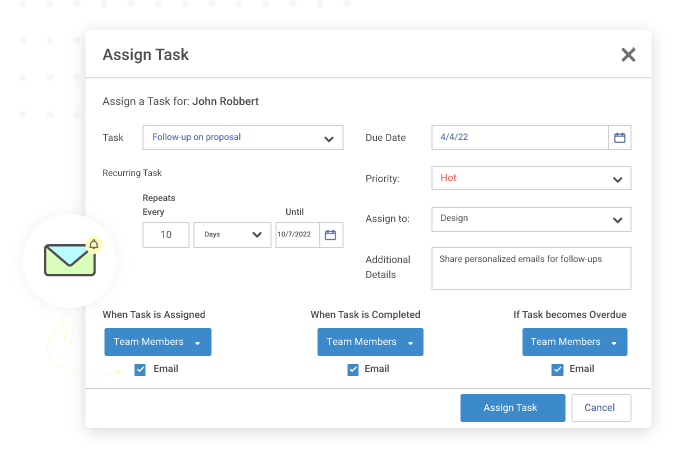
This is also a good time to assess whether your CRM supports these priorities. Many teams choose tools like BIGContacts CRM because they prefer something simple and organized. When your CRM aligns with your goals, it becomes much easier to deliver better customer experiences and long-term growth.
Frequently Asked Questions

Why should businesses pay attention to CRM stats?
CRM stats give you a clear picture of industry trends, adoption levels, and performance benchmarks. They help you understand what competitors are doing, justify budgets, and spot gaps in your own CRM usage. It’s an easy way to plan improvements with confidence instead of guesswork.
How accurate are CRM statistics?
Accuracy depends on the source. Stats from independent market research firms, government datasets, or analyst houses (like Gartner, McKinsey, or Fortune Business Insights) tend to be the most reliable. Using credible sources ensures your strategy is based on facts, not vendor-driven claims.
FREE. All Features. FOREVER!
Try our Forever FREE account with all premium features!